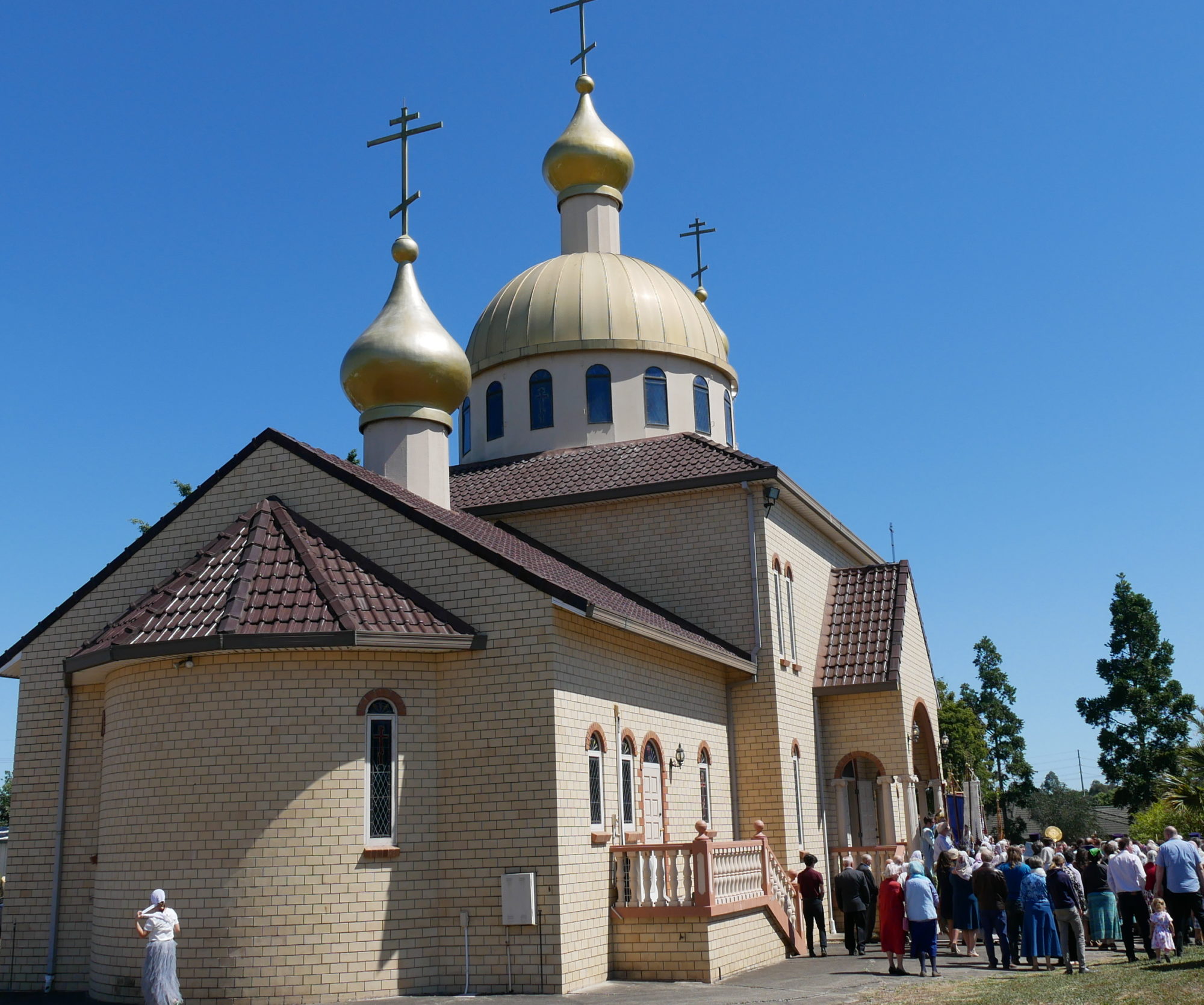
We often receive questions from new enquirers who are interested in attending our parish. This page seeks to provide some guidance based on the most common questions we receive.
Who are you and what do you believe?
We are followers of Our Lord Jesus Christ. We are Christians. We believe that He is God who took flesh in human form and came to save us sinners. Our faith is best summed up in the Nicene Creed which is described here.
I’m interested in the Orthodox Church. Can I come?
Yes. You are welcome to attend a service. However, please read the rest of this page so that you come prepared.
Do I need to understand Russian in order to attend?
No. Our Church services are predominantly served in the Church Slavonic language and with significant usage of English. However, the true language of the services is the inner language of prayer. Prayer is communication with God and begins when we open our hearts to Him in repentance and humility.
Can I participate?
You are welcome to attend and observe our services. However, to participate in the sacraments (e.g. to come to Confession or to receive Holy Communion) one must be a baptised and chrismated Orthodox Christian who has prepared oneself appropriately.
Is there a dress/behaviour code?
Yes. The Church is a place that is exclusively set aside for communal prayer. Therefore, anything that distracts others from prayer has no place in the Church. The dress code is therefore to wear clothing that is modest and does not draw attention to oneself. Wearing one’s “Sunday best” to Church is also a sign of respect to God – for in coming to Church, it is as if we are entering into an audience with the King of all Creation.
What constitutes modest dress?
For males, it typically means long trousers, a collared shirt without loud or stark brand names or logos, footwear that is equally reserved and which covers the feet. Bright sneakers are to be avoided. Males should have their heads uncovered in the church.
For females, it typically means a long dress or skirt, and a non-revealing top. Makeup should not be worn in Church, and if one is wearing lipbalm/chapstick it should be removed before venerating the icons as it leaves behind prints on the glass. Females traditionally should cover their heads, typically with a headscarf.
I get tired standing, why are there no pews? Can I move about?
Traditional Orthodox churches do not have pews, but some seating is provided for the old and infirm. It is not a sin to sit if one has injuries or illness, but if one is able to stand than it is better to do so. Making the effort to stand during the service while praying helps to keep the mind alert and focused on prayer. It is also a sign of respect before God. Especially, one should try to stand if one is physically able whenever the Royal Doors are open, when the Gospel is being read, and during the Eucharistic Canon (Anaphora) which is the holiest moment of the service.
Once the service has started, moving about generally is to be avoided, but if one needs to go outside to use the facilities, one should do so in a manner that is minimally disruptive to the other people who are praying. Quietly make an exit through the main doors of the church and return just as quietly and take your place.
What about putting up candles and venerating icons? What’s that about? Can I do that?
Orthodox Christians pray not just internally, but also physically. For example, we make the sign of the Cross, and bows (sometimes prostrations). We also purchase and place candles as a physical symbol of our prayer. The burning candle represents the light of our prayer and is an offering to God.
Upon entering the Church, the faithful will typically buy a candle (or several), then go to an icon, make the sign of the cross twice with two bows, kiss the icon in veneration (giving on honour) to Christ, the Virgin Mary or to the holy saint (one who has been set aside by God and is recognized to be a holy person whose prayers for us are sought by us), light the candle and place it in the candlestand, then make a third sign of the Cross and bow and take up their place in the Church.
Yes, everyone is free to do this, even if you are new. It would be recommended to observe others doing this first.
We should not be placing candles during the main part of the Liturgy. Again, this is to avoid distraction of others from prayer and also so as not to interfere with flow of the service. It’s better to arrive early, and place our candles before the service (or at least during the reading of the Hours prior to Liturgy).
I don’t understand what’s going on in the service. How can I find out more?
The services are complex and multi-layered. At their most fundamental level, they are based mostly on Psalms and Scripture (both Old Testament and New). They also contain information about the feast day we are celebrating, the appointed saints of the day, and information about the Faith itself, including the Revelations given to humanity by God. They come from the very earliest days of the Church and have continued to acquire additional content throughout history as new saints have been revealed to us. Understanding them, therefore is not an instant process, but rather a life-long journey.
Knowledge of the services is best acquired through several pathways simultaneously:
1) Ask the priest after the service is finished
2) Attend one of the many catechism classes run by our clergy
3) Read one of the many explanations of the Orthodox services online
4) Acquire a prayer book containing the outline of the services and follow along during the service
5) Attend the services frequently and regularly
6) Pray fervently to God to reveal the meaning of the services to you.
The most important function of the Church services is to provide an prayerful and reverent environment to the people standing in Church and praying together so that they can better focus on their own prayers. The central function of the Divine Liturgy service (specifically) is the Eucharist (Holy Communion).
What is the Russian Orthodox Church’s stance on the issue of x, y or z?
Ask the priest after the service, attend catechism classes, and read official church publications on the topic. If a particular issue is not mentioned, remind yourself of the function of the Church on Earth – i.e. its mission – which is to call all nations to Salvation, to free us from the eternal suffering, from spiritual delusion, and to give us a knowledge of the Truth. If the issue in question does not contribute to this mission, then it is, at best, irrelevant, or at worst a distraction which runs the risk of knocking from our path God.
Which version of the Bible do you use? I heard that the King James Version is the only authoritative version.
The New Testament was originally written in Koine Greek. This is often called the “Received Text”. Most of our services are in the Church Slavonic Language. The Church Slavonic text used is a direct and faithful translation of the “Received Text” Greek original. Whenever we serve in English, the English text we use for the New Testament is typically the King James Version or New King James Version.
The Old Testament was original recorded in Hebrew, however, as a result of history, there is no authoritative equivalent of a “Received Text” in the Hebrew language. The undisputed reality is that the oldest authoritative version of the Old Testament is the Septuagint (LXX), which is a translation into Greek which was done between the 3rd and 2nd Centuries BC. Both the Church Slavonic and English translations we use are direct translations of the Septuagint. A number of articles explaining why the Orthodox Church universally uses the Septuagint are here:
https://theorthodoxlife.wordpress.com/2012/03/12/masoretic-text-vs-original-hebrew/
https://fatherjohn.blogspot.com/2015/08/stump-priest-septuagint-vs-masoretic.html
I want to become an Orthodox Christian. Can I do this? What are the steps?
Orthodox Christianity is the original faith of the Apostles. The Apostles were directly charged by Christ as described in Matthew 28:19:20 wherein He commanded them “Go ye therefore, and teach all nations, baptizing them in the name of the Father, and of the Son, and of the Holy Ghost: Teaching them to observe all things whatsoever I have commanded you: and, lo, I am with you alway, even unto the end of the world. Amen.”
The answer to this question is therefore plain: yes, you can become an Orthodox Christian, and the steps are described by Christ: you must be baptised in the name of the Father, the Son and the Holy Spirit. Importantly also, you must be taught to observe all things whatsoever He has commanded the Apostles.
Reception into the Orthodox faith therefore, typically starts by a person coming to Church regularly and learning about the Faith – from the services, the priest, catechism classes and through absorbing and assimilating the life of the Church. Assuming they still have a firm intention to become Orthodox, after some time (which can vary depending on the person and their specific needs), they will be made given the prayers making them a Catechumen, and then some time after that, they will be Baptised and Chrismated and begin their new life in Christ.
It is important not to rush this process, since it takes time for a person to fully comprehend and assimilate everything, and Orthodox Christianity is a way of life, and is important that that one considering become Orthodox is given every opportunity and help to be able to sustain their faith throughout all of life’s difficulties and challenges.
Do you have any recommendation on prayers I can say every day?
Over two millennia, great saints wrote down prayers that they used personally, and which others around them found poignant and useful. According to the practice of the Orthodox Church, prayers are said in the morning (after waking) and in the evening (before bed), before and after meals, in times of trouble, sickness, before travel, in thanksgiving and many other occasions. Some are lengthy, and others are surprisingly short.
The Jesus Prayer
The simplest and among the shortest of prayers commonly recited by Orthodox Christians is the Jesus Prayer. It can be said continuously at any time of day or night, and while undertaking various tasks. This prayer is most commonly recited with the words:
“Lord Jesus Christ, Son of God, have mercy on me a sinner”
Morning Prayers / Evening Prayers
Prayers after arising from sleep and before sleep are said daily at the appointed times. These can be found here: https://orthodox-europe.org/english/liturgics/prayers/morning-and-evening-prayers/
Prayers for and after meals
Prayers before and after meals are described here: https://www.saintjonah.org/services/meal.htm
Various personal prayers for various occasions
A more general set of prayers can be found here: https://www.saintjonah.org/services/prayers.htm